How to Automate Lead Qualification for SaaS Companies
Feb 27, 2026

How to Automate Lead Qualification for SaaS Companies
SaaS companies can automate lead qualification by implementing signal-based workflows that combine traditional frameworks like BANT with AI-powered enrichment tools. Modern platforms enable real-time scoring based on behavioral triggers, reducing qualification time by 70% while improving SQL conversion rates to 15-20%. The key is connecting enrichment APIs, scoring logic, and CRM routing into a unified system that identifies high-intent buyers automatically.
TLDR
- Manual lead qualification wastes 64% of sales reps' time on admin work instead of selling, while AI frees up 11.5 hours weekly for customer engagement
- Signal-based scoring monitors job changes, funding rounds, hiring patterns, and website behavior to identify buying intent in real time
- Orange Slice offers a programmable spreadsheet platform with 100+ built-in enrichments where every column runs TypeScript code
- Proper automated qualification improves MQL to SQL conversion from 2-5% to 15-20% while reducing research time by 70%
- Implementation requires defining ICP criteria, building trigger workflows, setting scoring thresholds, and establishing clear marketing-to-sales handoffs
SaaS sales teams are drowning in data. Every day, inbound forms, website visits, LinkedIn engagements, and CRM updates generate more leads than any human team can realistically evaluate. The result? Revenue slips through the cracks while reps burn hours on prospects who were never going to buy.
The solution is clear: companies now must automate lead qualification to compete. This guide walks through the frameworks, signals, tools, and implementation steps required to build a system that identifies high-intent buyers and routes them to sales at exactly the right moment.
Why SaaS Teams Can't Afford Manual Lead Qualification Anymore
Manual qualification doesn't scale. As lead volume grows, the gap between marketing-qualified leads (MQLs) and sales-qualified leads (SQLs) widens, and conversion suffers.
Consider the numbers: sales reps spend only 36% of their time actually selling, according to Salesforce research. The rest disappears into admin work, data entry, and chasing unqualified prospects. Meanwhile, 84% of business leaders acknowledge that the marketing-to-sales handoff is one of the most significant challenges they face in aligning their teams effectively.
The opportunity cost is staggering. AI can help free up an additional 11.5 hours a week for customer engagement, transforming time wasted on manual triage into active selling.
Key takeaway: Without automation, your team is likely spending more time researching leads than closing deals.
Which Lead-Qualification Frameworks Still Matter in 2026?
Classic frameworks provide the foundation, but modern SaaS sales cycles demand flexibility.
BANT: The Foundation
BANT stands for budget, authority, need, and timeline. It assesses "how much money a lead can or is willing to spend, if they are the ultimate decision maker or have influence on the buying decision, whether they have a business problem your product or service can solve, and how much time they need to make a purchase decision," according to Gartner's framework guide.
Over 52% of salespeople still find BANT reliable, with 41% valuing its flexibility. However, BANT works best as a guide rather than a rigid checklist.
MEDDIC and CHAMP: For Complex Deals
MEDDIC (Metrics, Economic Buyer, Decision Criteria, Decision Process, Identify Pain, Champion) was designed for longer, enterprise sales cycles. It excels at identifying political and technical hurdles early.
CHAMP (Challenges, Authority, Money, Prioritization) flips the script by leading with challenges rather than budget, making it effective for consultative selling.
Where Automation Fits
Gartner reports that nearly 60% of SaaS deals now involve four or more stakeholders, significantly complicating qualification. Rigid frameworks struggle in these multi-stakeholder environments.
The solution? Hybrid models that combine traditional frameworks with behavioral insights and automation. Platforms can trigger lead scoring not from static fields, but from behavioral events such as webinar attendance, feature engagement, or intent signals.
| Framework | Best For | Automation Potential |
|---|---|---|
| BANT | SMB, fast sales cycles | High (clear criteria) |
| MEDDIC | Enterprise, complex deals | Medium (requires human input) |
| CHAMP | Consultative sales | High (challenge-first signals) |
What Real-Time Data Signals Power Automated Scoring?
Static CRM data ages fast. Roles shift, budgets change, teams grow, and companies open new initiatives every week. The difference between winning and losing a deal often comes down to timing.
The Data Enrichment Layer
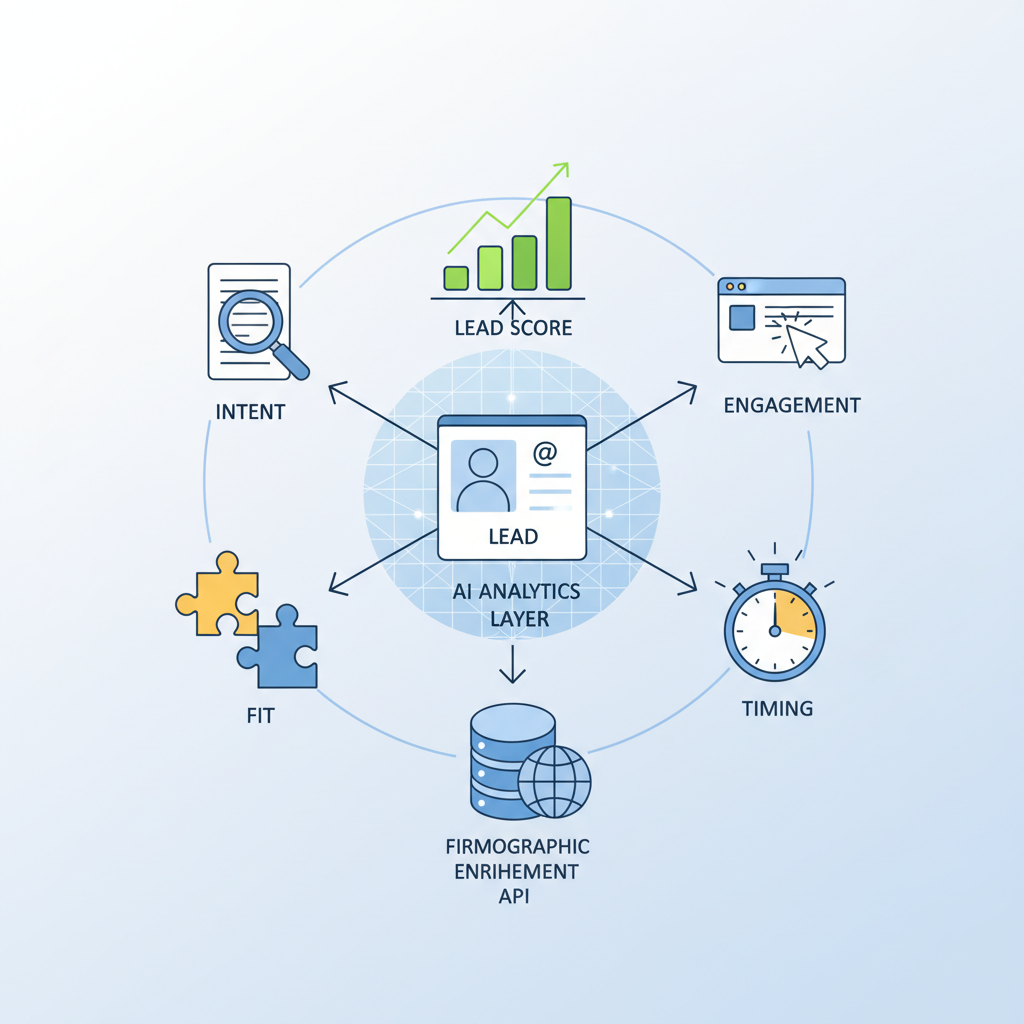
A Data Enrichment API is "an automated tool that transforms minimal known data points into comprehensive, structured profiles," as defined by Crustdata's enrichment guide. These APIs pull firmographic, technographic, and behavioral data from external sources in real time.
B2B data becomes outdated as people change jobs every 3.9 years on average in the US. Without continuous enrichment, your CRM becomes a graveyard of stale records.
Signal Types That Matter
Lusha Signals turn real business movement into actionable events. You can enrich contacts and companies with four verified signal types: "job change, promotion, headcount growth, and new job listings."
- Intent signals suggest that a prospect is actively researching a problem or solution space
- Engagement signals reflect direct interaction with your outreach or assets
- Fit signals describe how closely a prospect matches your ideal customer profile
- Timing signals indicate recency, urgency, or unusual activity
How AI Interprets Signals
"AI systems monitor signal sources continuously, rather than reviewing them periodically," according to Amplemarket's signal-based selling guide. AI looks for patterns across signals, especially when multiple weak signals occur close together, creating a compound indicator of buying intent.
Key takeaway: Signal-based selling is dynamic. Signals appear, peak, and fade. Automation ensures you act while the window is open.
How Does Orange Slice Compare to Clay, Apollo & Others?
The lead enrichment market has fragmented. Teams now evaluate tools based on predictability, workflow alignment, and operational stability rather than feature lists alone.
Common Platform Limitations
"Lead enrichment tools used to be simple data appenders. As they became embedded into routing, scoring, and personalization logic, minor inconsistencies began introducing major operational friction," notes Pintel's tool comparison.
Many tools reinterpret titles during dataset refreshes. A "Head of Marketing" might become a "Marketing Lead," shifting seniority, scoring, and routing logic unexpectedly.
Apollo combines sourcing, enrichment, and sequencing in one environment, delivering 224M verified contacts with 96% email accuracy. However, teams report variability in classification consistency.
Clay offers workflow flexibility by letting teams chain multiple data sources, transformations, and logic layers. The tradeoff? Operational complexity increases as workflows scale.
"Consolidating enrichment with sales engagement in one platform can cut your tech stack costs in half while improving workflow efficiency."
Orange Slice's Programmable Workflow Layer
Orange Slice takes a different approach. "Orange Slice is a spreadsheet where every column is TypeScript -- and AI writes it for you," according to Y Combinator's company profile.
The platform's fully-typed SDK has 100+ enrichments built in: LinkedIn, contact info, company data, web scraping, and AI research. Orange Slice turns the spreadsheet into a system for discovering buying signals, with agents researching company sites, news, social signals, and niche sources like court records or building permits, then structuring that information directly into columns teams can act on.
Backed by Y Combinator with $5.3M in seed funding, Orange Slice is designed to handle niche, complex GTM questions that other tools fail to answer.
| Platform | Strength | Limitation |
|---|---|---|
| Apollo | Scale and speed | Classification variability |
| Clay | Workflow customization | Operational complexity |
| Clearbit | Clean firmographics | Limited person-level depth |
| Orange Slice | Programmable logic, natural-language workflows | Newer to market |
How Do You Automate Lead Qualification with Orange Slice? A 6-Step Playbook
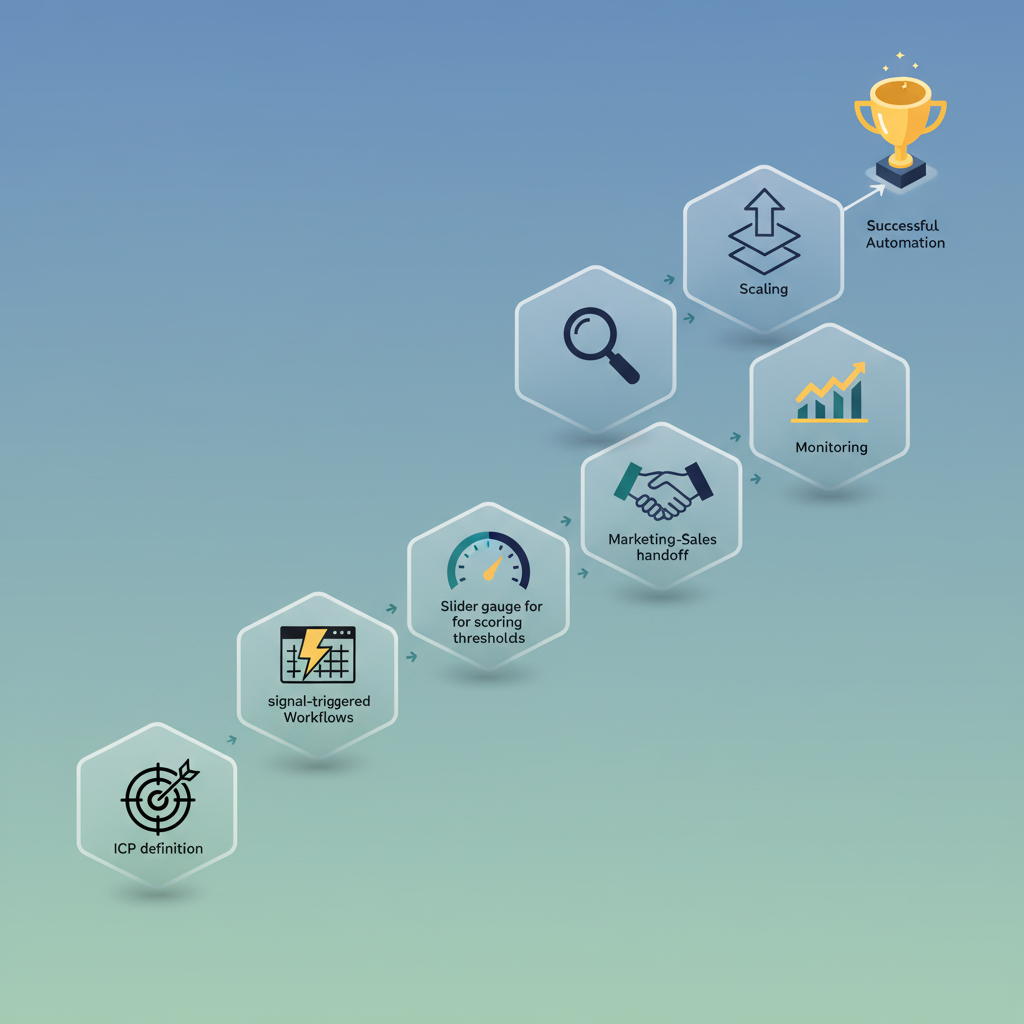
Implementation requires more than selecting a tool. You need a systematic approach that connects qualification criteria, scoring logic, and routing workflows.
"A well-designed lead qualification process transforms chaos into a predictable system that surfaces your best opportunities and routes them to sales at exactly the right moment," according to Orbit AI's qualification guide.
1. Define & Weight Your ICP Criteria
"By defining the ICP for your products or services, you create a set of criteria against which you'll compare your leads to qualify them," explains Clay's AI qualification guide.
Start with 5-7 key attributes maximum. More criteria doesn't mean better qualification; it means more complexity and slower iteration.
Orange Slice can auto-score fields including: company size and revenue range; industry vertical; technology stack indicators; hiring activity and headcount trends; funding stage and recent announcements; and geographic location.
AI can analyze information on your existing customers and recognize patterns to identify shared characteristics, making ICP refinement an ongoing process rather than a one-time exercise.
2. Build Signal-Triggered Workflows in Orange Slice
Orange Slice enables you to "Alert me in Slack when potential customers comment on my LinkedIn posts, then qualify and route inbound leads automatically," as shown in the platform's workflow examples.
Map triggers to actions. For example: LinkedIn engagement triggers enrich + score + alert in Slack; website pricing page visit triggers qualify against ICP + route to AE; job posting for relevant role triggers add to nurture sequence; and funding announcement triggers prioritize for immediate outreach. Orange Slice integrates directly with systems like HubSpot to automate operational sales processes. When a deal changes stage, the platform can "generate a complete deal note with context, risks, and next actions."
Set scoring thresholds. Your scoring model translates qualification criteria into a numerical system that prioritizes leads automatically. Create rules that route qualified leads to the appropriate sales rep or team based on score bands: Hot (80+) gets immediate AE assignment + Slack alert; Warm (50-79) gets SDR follow-up within 24 hours; and Nurture (below 50) enters automated email sequence. Negative scoring is just as important as positive points. Deduct for mismatched industries, small company size, or student email domains.
Establish the handoff process. A smooth handoff requires clear agreements between marketing and sales: shared definitions, recycling protocol, feedback loop, and service level agreement (SLA), according to Prediqte's inbound guide.
Monitor and refine. "AI takes over mundane or repetitive tasks like market and lead research and data enrichment." But supervision remains essential. Even the best tools don't guarantee successful lead qualification without human involvement. Schedule quarterly reviews to recalibrate scoring weights based on actual conversion data.
Which KPIs Prove Your Automation Works?
Measurement separates systems that improve over time from ones that ossify around initial assumptions.
Core Metrics
| Metric | Benchmark | Why It Matters |
|---|---|---|
| MQL-to-SQL conversion | 2-5% (MQL), 15-20% (SQL) | Proper qualification dramatically improves conversion |
| Qualification time reduction | 70% decrease | Automated scoring reduces manual research |
| Close rate improvement | 20-30% lift | Better-qualified leads close at higher rates |
| Content-to-sales alignment | 12% higher acceptance | Organizations that prioritize content correlating with previous sales see better results |
"MQLs convert to customers at 2-5%, while SQLs convert at 15-20% -- proper qualification matters," according to Prediqte's research.
"Organizations that prioritize content pieces that correlate with previous sales have a 12% higher sales acceptance rate."
Signal Effectiveness
Signal-based selling is dynamic. Signals appear, peak, and fade. Track which signal types correlate most strongly with closed-won opportunities: job change signals often indicate budget reassessment windows; funding announcements correlate with tool evaluation cycles; and hiring patterns suggest scaling needs.
Key takeaway: Automated lead scoring can reduce qualification time by 70% while improving accuracy. Measure both efficiency gains and quality improvements.
Pitfalls to Avoid When Scaling Automated Qualification
Automation introduces new failure modes. Anticipating them prevents costly resets.
Integration Complexity
"Integrating AI tools into your existing tech stack can be time-consuming and complex," warns Clay's implementation guide. Start with a single workflow before expanding. Prove value in one area before adding complexity.
Over-Enrichment and Schema Drift
"Some lead enrichment tools add too many fields or overly granular attributes. Others create new CRM fields automatically," notes Pintel's comparison.
This creates three problems: CRM bloat that confuses reps; routing logic breaks when field names change; and reporting becomes unreliable.
Classification Drift
"Classification drift breaks routing. Many tools reinterpret job titles during data refreshes. A 'VP of Sales' becomes 'Sales VP' or 'Head of Sales,' shifting seniority mappings," according to Pintel's qualification tools analysis.
Choose platforms with stable classification layers or build validation checks into your workflows.
Over-Reliance Without Supervision
AI tools can make mistakes. If you blindly rely on them to qualify leads, you could end up reaching out to accounts that don't fit your ICP. "Supervise your AI solution -- even the best tools don't guarantee successful lead qualification without human involvement."
Automated Qualification Is Table Stakes -- Start Building Now
The companies winning in 2026 aren't debating whether to automate lead qualification. They're competing on how effectively they execute it.
Orange Slice offers a programmable approach that adapts to your unique sales motion. With $5.3M in seed funding and Y Combinator backing, the platform provides the infrastructure for fully automated, customizable sales workflows.
The gap between manual qualification and automated systems will only widen. Teams that build now gain compounding advantages: better data, faster iteration, and more time spent on actual selling.
Start with one workflow. Prove the ROI. Then scale.
Frequently Asked Questions
Why is manual lead qualification no longer effective for SaaS companies?
Manual lead qualification is inefficient as it doesn't scale with the increasing volume of leads. Sales reps spend a significant amount of time on administrative tasks rather than selling, leading to missed opportunities and lower conversion rates.
What are the key lead-qualification frameworks mentioned in the blog?
The blog discusses BANT, MEDDIC, and CHAMP frameworks. BANT is suitable for SMBs with fast sales cycles, MEDDIC is ideal for complex enterprise deals, and CHAMP is effective for consultative sales, focusing on challenges first.
How does Orange Slice enhance lead qualification processes?
Orange Slice automates lead qualification by integrating real-time data signals and programmable workflows. It uses AI to continuously monitor and interpret signals, ensuring timely and accurate lead scoring and routing.
What types of data signals are crucial for automated lead scoring?
Key data signals include intent signals, engagement signals, fit signals, and timing signals. These signals help identify prospects' research activities, interactions, alignment with ideal customer profiles, and urgency.
What are the common pitfalls in scaling automated lead qualification?
Common pitfalls include integration complexity, over-enrichment leading to CRM bloat, classification drift affecting routing logic, and over-reliance on AI without human supervision, which can lead to misqualified leads.
Sources
- https://www.prediqte.com/blog/inbound-lead-qualification
- https://news.linkedin.com/2024/October/newAIcapabilitiesinSalesNavigator
- https://www.ycombinator.com/companies/orange-slice
- https://www.gartner.com/en/digital-markets/insights/generate-high-quality-leads
- https://www.gartner.com/en/digital-markets/insights/bant-framework
- https://www.equanax.com/blog-1/modern-saas-sales-qualification
- https://resources.rework.com/libraries/saas-growth/saas-sales-qualification
- https://crustdata.com/blog/data-enrichment-api
- https://www.lusha.com/blog/lusha-signals-api/
- https://www.amplemarket.com/blog/signal-based-selling
- https://pintel.ai/blogs/lead-enrichment-tools-compared-apollo-clay/
- https://www.apollo.io/insights/data-enrichment-tools
- https://www.orangeslice.app/
- https://orbitforms.ai/blog/lead-qualification-process
- https://www.clay.com/blog/ai-lead-qualification
- https://orangeslice.ai/
- https://pintel.ai/blogs/best-lead-qualification-tools-for-b2b-revenue-team/