How to Design Scalable Sales Workflows for Fast-Growing SaaS Companies
Feb 27, 2026

How to Design Scalable Sales Workflows for Fast-Growing SaaS Companies
Scalable sales workflows for SaaS companies combine real-time signal detection, AI-powered qualification, and automated orchestration across your tech stack. Companies using AI-enabled platforms report 30% higher win rates and 25% faster deal cycles, while early automation adopters see 10-15% efficiency improvements and up to 10% sales uplift.
Key Takeaways
• Signal detection drives timing: Monitor hiring triggers, funding events, and job changes to reach prospects when they're actively evaluating tools, achieving 15-25% reply rates versus 1-2% for cold outreach
• AI qualification scales consistently: Automated lead scoring and routing increases sales team efficiency by 70% while maintaining uniform qualification standards
• Tech stack ROI matters: AI-native tools deliver 241% ROI in 7 days compared to 87% ROI in 90 days for traditional CRMs
• Speed beats competition: Agentic systems respond to buying signals in under 15 minutes versus 4-6 hours for manual processes
• Data governance prevents failure: B2B contact data decays at 70.3% annually, requiring continuous enrichment and standardized field formats
• Phased rollout ensures adoption: Start with one high-impact workflow, prove value with measurable metrics, then expand systematically to avoid workflow sprawl
Scalable sales workflows let SaaS companies compound growth by turning real-time buying signals into automated actions. When a prospect visits your pricing page, posts about a competitor pain point on Reddit, or hires a new VP of Sales, the right workflow captures that signal and routes it to the correct rep within minutes. This guide breaks down the components, tech-stack decisions, rollout steps, and metrics you need to build workflows that will still work at Series C and beyond.
Why Are Scalable Sales Workflows a Growth Multiplier for SaaS?
Manual sales processes do not scale. Reps spend hours researching prospects, updating CRM fields, and chasing leads that never convert. According to McKinsey, early adopters of sales automation consistently report efficiency improvements of 10 to 15 percent alongside higher customer-facing time and up to 10 percent sales uplift.
At the same time, 75% of B2B sales organizations are expected to augment traditional playbooks with AI-guided selling solutions by 2025, according to Gartner. The companies that fail to modernize risk falling behind competitors who respond to buying signals in minutes rather than days.
The cost of sticking with manual workflows is not only inefficiency. A benchmark of 938 B2B companies found that the average sales tech stack includes 8.3 tools costing $187 per rep per month, yet 73% of teams use overlapping tools with 40-60% functional redundancy, wasting $2,340 per rep annually. Scalable workflows consolidate signal detection, qualification, and enrichment into a unified layer, eliminating redundant software and manual hand-offs.
Key takeaway: Scalable sales workflows reduce cost, increase rep productivity, and position your team to capture more of the market before competitors can react.
What Makes a Sales Workflow "Scalable"?
A scalable sales workflow is not simply a series of Zapier automations that pass data between tools. As one industry expert put it, "An agentic LLM pipeline isn't conventional automation; it is orchestration. Instead of firing off one-off user prompts, it links multiple reasoning steps into a complex system that can actually think through the sales journey and make decisions."
Agentic AI platforms represent a new class of unified environments where multiple autonomous agents work together to accomplish complex objectives. According to PwC, two-thirds of adopters report increased productivity and over half see significant cost savings.
An AI sales agent goes beyond static workflows. These systems "can have human-like conversations across channels (email, chat, SMS, or voice), understand buyer intent, handle multiple back-and-forths, and autonomously move leads through the funnel."
The distinction matters because simple automation breaks under edge cases. A scalable workflow handles exceptions, adapts to new qualification criteria, and learns from rep feedback. Generic automation moves data from step to step; AI workers execute the full qualification process with context, decisions, and measurable outcomes.
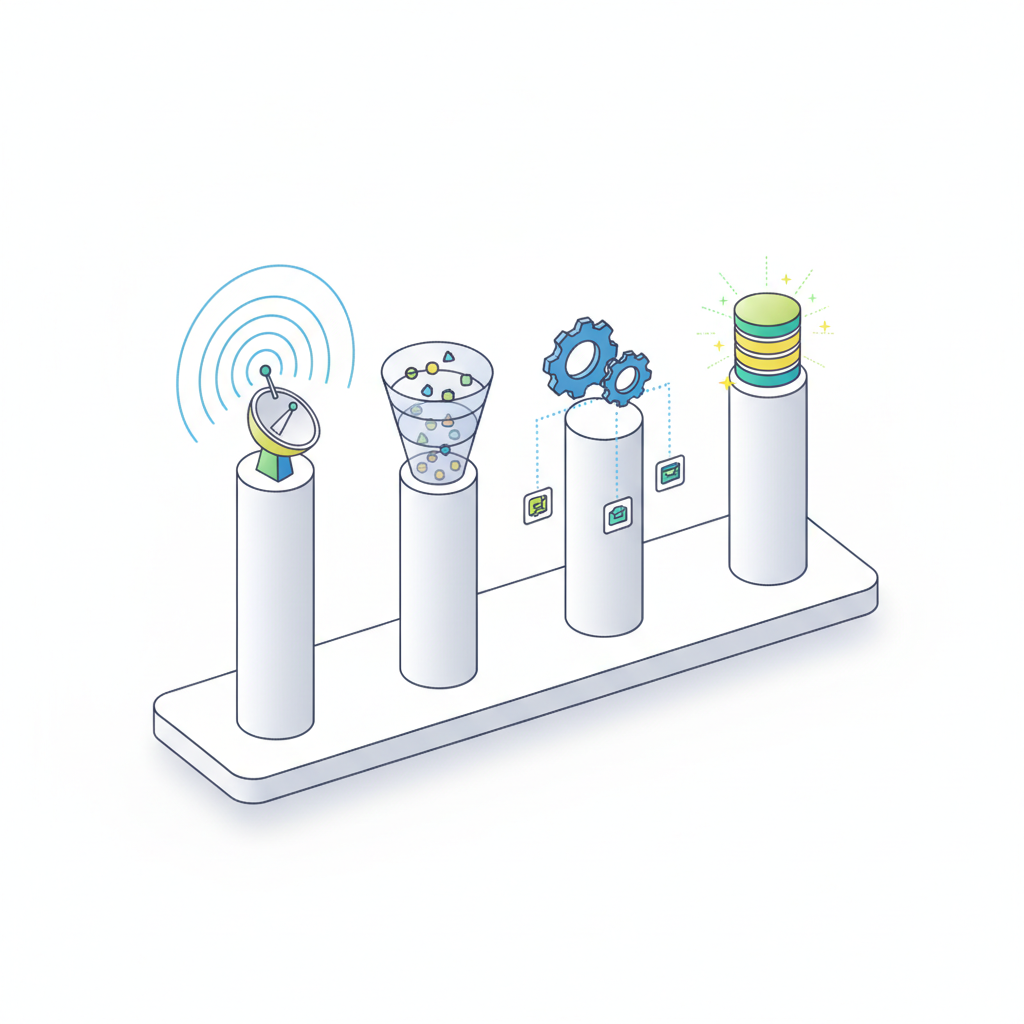
Core Building Blocks: Signals, Qualification, Orchestration & Enrichment
Every scalable workflow rests on four pillars: detecting high-intent signals, automating lead qualification, orchestrating actions across your stack, and enriching records with accurate, up-to-date data.
A complete AI sales research workflow consists of five interconnected components: Signal Detection Layer, Qualification Engine, Contact Intelligence, CRM Integration, and Analytics and Optimization.
An AI sales agent for lead qualification is an "always-on digital worker that engages inbound and outbound leads, asks the right questions, verifies fit (ICP, intent, timing), enriches records, and routes qualified opportunities to the right rep."
A Data Enrichment API is "an automated tool that transforms minimal known data points into comprehensive, structured profiles." Without enrichment, your CRM decays rapidly. B2B data becomes outdated annually as people change jobs every 3.9 years on average in the US.
1. Detect High-Intent Signals
The best workflows act on signals that indicate buying intent before a prospect fills out a form. Key triggers include:
-
Hiring signals: When a company posts a VP of Sales role, they are likely scaling their go-to-market. Reaching out to a newly hired VP in their first 90 days, when they are actively evaluating tools, can see reply rates of 15-25% versus 1-2% for cold outreach.
-
Funding events, tech adoption, and social posts: Autobound's Signal Engine monitors job changes, funding events, tech adoption, and social media posts, automatically pushing contacts into outbound campaigns the moment they match your criteria.
-
Job change re-activation: Job Change Signals identify when a contact has moved roles or companies. These transitions are strong indicators of renewed buying intent, especially for prospects who evaluated your product in the past.
2. Automate Lead Qualification & Routing
Once signals are detected, AI agents score and route leads based on your ICP and qualification framework.
Magical's agentic platform claims to "automatically score and qualify incoming leads based on fit and intent, increasing your sales team's efficiency by 70%." The system analyzes firmographic data, behavioral signals, and intent data to score every lead consistently.
The AI agent keeps CRM data clean by standardizing fields, enforcing required properties, and logging a consistent qualification summary every time. You prevent bad meetings by enforcing a qualification gate: the AI agent only books when required fields are confirmed and confidence is above a threshold.
3. Orchestrate Actions Across Your Stack
With signals captured and leads qualified, orchestration platforms tie everything together. HubSpot's developer platform offers core automation tools including Workflows, Webhooks, Custom objects, App cards, APIs, and Agent tools to build smarter, AI-ready automations.
For teams using n8n or similar orchestration layers, a real-time sales pipeline analytics workflow can query your CRM API (HubSpot, Salesforce, or Pipedrive) on a schedule, pull pipeline data, and feed it into OpenAI for anomaly detection. Summaries and alerts appear in Slack, while daily snapshots are archived in Google Sheets for trend analysis.
How Do You Choose an AI-Native Tech Stack That Won't Crumble at Series C?
Not all AI CRM tools are created equal. Companies using AI-enabled sales platforms report 30% higher win rates and 25% faster deal cycles. But the distinction between AI-first and AI-bolted-on matters.
A benchmark study found that tools with an AI Native Score above 80 achieve 2.8x higher ROI (241%) versus non-AI tools (87%). AI CRMs also achieved the fastest Time to Value, delivering first measurable ROI in 7 days versus 90 days for traditional CRMs.
HubSpot launched AI Agents and Breeze Copilot together. One runs workflows autonomously while the other assists humans. Salesforce built Agentforce on top of Einstein AI. These agents do not just suggest actions; they take them.
Forrester research notes that three out of four companies have invested in AI agents in the last year, and respondents report a median 40% cost-per-unit savings for their most mature workflows.
The bottom line is to evaluate tools on their AI Native Score, Time to Value, and whether they integrate natively with your existing CRM. Avoid layering point solutions that create functional overlap.
| Criteria | AI-Native Tool | Legacy + AI Bolt-on |
|---|---|---|
| Time to Value | 7 days | 90 days |
| ROI | 241% | 87% |
| Integration | Native CRM sync | Manual exports |
How Do You Roll Out a Step-by-Step Blueprint at Your SaaS Startup?
Implementing scalable workflows requires a phased approach with humans in the loop.
-
Audit current processes: Map every manual step in your sales funnel. Identify bottlenecks where leads stall or data quality degrades.
-
Define goals and metrics: Set targets for speed-to-lead, qualified meeting rate, and CRM field completion before you deploy.
-
Build workflows incrementally: Start with a single high-impact workflow, such as inbound lead qualification. Origami Agents recommends defining your Ideal Customer Profile, mapping buying signals, selecting an AI platform, and integrating with CRM systems.
-
Test, then monitor: HubSpot's developer guidance emphasizes the need to build, test, and monitor automations before rolling them out widely.
-
Expand scope: Once the pilot proves value, add workflows for outbound signals, deal-stage automation, and competitive monitoring.
Monthly investment for a mid-market team might look like: AI platform cost of $2,000, team time for setup and optimization of $3,000, totaling $5,000 per month. If the workflow generates 200 qualified leads, 50 demos, and 10 closed deals at an average deal size of $25,000, monthly revenue reaches $250,000, yielding a 4,900% ROI.
Data Governance & Change Management
Workflow automation fails when data quality is poor or reps do not trust the system.
Unified data governance is "the practice of setting shared rules for how customer data is collected, formatted, stored, and accessed across the business." Without governance, AI agents inherit bad data and produce bad outputs.
McKinsey found that 90% of companies that successfully scale automation invest more than half of their budgets in change management and capability building. Training reps on how to interpret AI recommendations and when to override them is as important as the technology itself.
Data hygiene checklist:
- Standardize field formats across CRM objects
- Deduplicate records weekly
- Enforce required properties before deal stage progression
- Monitor enrichment accuracy monthly
Which Metrics Prove ROI to Investors & Revenue Leaders?
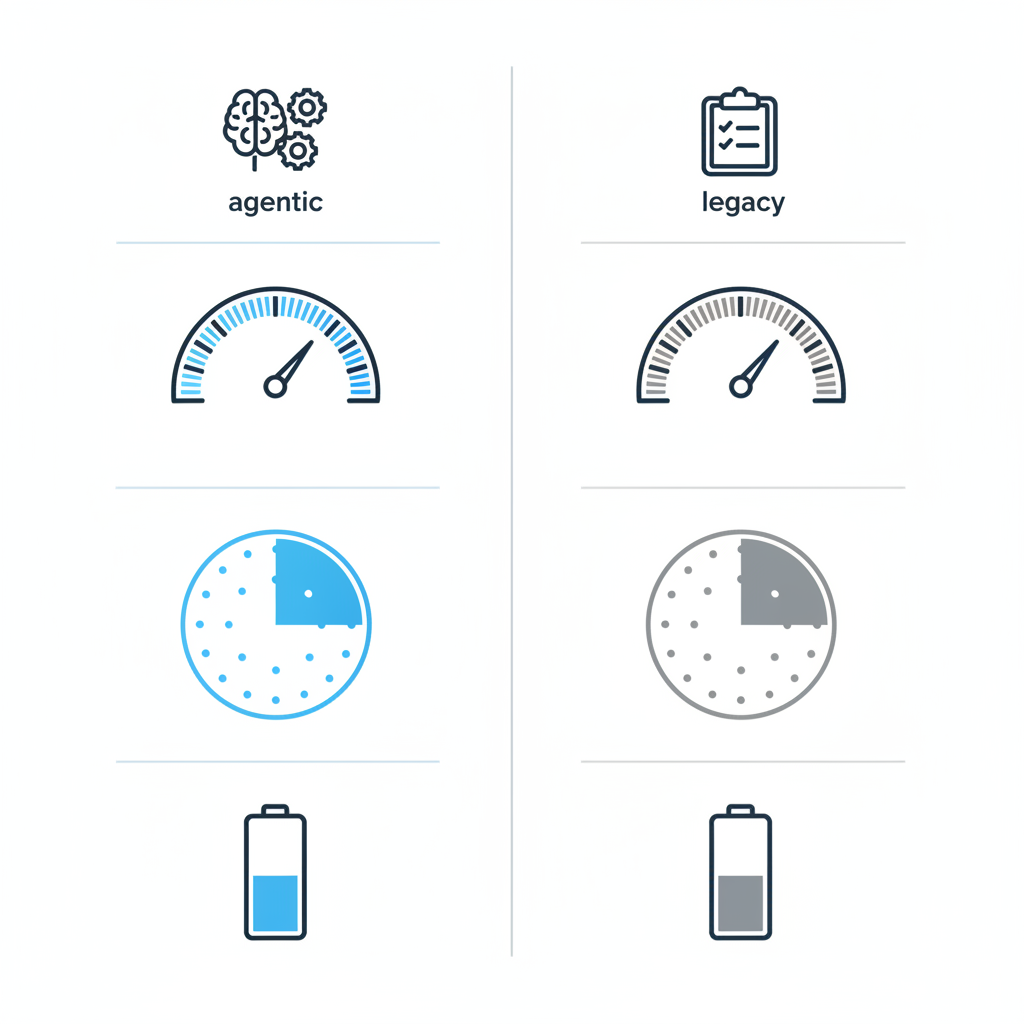
Investors and boards want to see concrete evidence that your sales infrastructure is working. Focus on three dimensions.
Speed: Agentic Leaders respond to buying signals 87% faster, with median response times under 15 minutes versus 4-6 hours for legacy teams.
Coverage: They achieve account coverage rates exceeding 95% across their total addressable market, compared to 40-60% coverage in rep-limited models.
Efficiency: One benchmark showed open rates increased from 18% to 54% with AI-assisted personalization. AI CRMs deliver results in 7 days versus 90 days for traditional tools. Combined, these metrics can deliver up to 287% ROI for AI-native stacks.
Follow-up consistency reaches 98% in agentic systems versus 45-70% in human-dependent workflows. Most significantly, Agentic Leaders report pipeline leakage rates 60% lower than traditional teams.
Common Failure Modes—and How to Avoid Them
Even well-designed workflows can fail. Here are the pitfalls to watch for.
Spam risk: As one practitioner warned, "The biggest danger with integrating AI agents into sales workflows isn't the AI itself, it is blind trust. If you don't put proper safeguards in place, you risk spamming prospects with convincing nonsense." Always have human review for high-value accounts and set throttling limits on outbound volume.
Data decay: B2B contact data decays at 70.3% annually, with monthly decay accelerating to 3.6% by late 2024. Enrichment must be continuous, not a one-time import.
Organizational readiness: Forrester notes that "despite rapid capability advancement, the top barrier holding organizations back isn't functionality; it's readiness." Misaligned incentives, lack of training, and siloed data all undermine automation ROI.
Compliance: GDPR fines reached €1.2 billion in 2024 alone. Before deploying AI agents that touch personal data, ensure your workflows meet consent and transparency requirements.
Workflow sprawl is another risk. Resist the urge to automate every edge case at once. Start small, prove value, and expand methodically.
The Road Ahead: Make Workflows Your Competitive Moat
Scalable sales workflows are no longer optional for fast-growing SaaS companies. They are the infrastructure that separates teams responding to signals in minutes from those who lose deals to faster competitors.
The key actions are straightforward: audit your current processes, choose an AI-native stack that integrates with your CRM, roll out workflows incrementally with humans in the loop, and measure speed, coverage, and efficiency relentlessly.
For teams ready to build this infrastructure, Orange Slice offers a programmable platform that lets you "scrape websites, monitor LinkedIn, enrich your CRM, build automated workflows, and research competitors—all on autopilot." Backed by Y Combinator and with $5.3 million in seed funding, Orange Slice is designed for GTM agencies and fast-moving startups that need to build and iterate go-to-market workflows quickly, handling the niche, complex GTM questions that other tools fail to answer.
Frequently Asked Questions
What are the benefits of scalable sales workflows for SaaS companies?
Scalable sales workflows help SaaS companies reduce costs, increase rep productivity, and capture more market share by automating the response to real-time buying signals, thus improving efficiency and sales uplift.
How do scalable sales workflows differ from traditional automation?
Unlike traditional automation, scalable sales workflows involve orchestration with AI agents that can think through the sales journey, handle exceptions, and adapt to new criteria, providing a more dynamic and reliable process.
What are the core components of a scalable sales workflow?
The core components include detecting high-intent signals, automating lead qualification, orchestrating actions across your tech stack, and enriching records with accurate data to ensure a seamless and efficient sales process.
How can Orange Slice help in building scalable sales workflows?
Orange Slice offers a programmable platform that automates sales workflows by integrating market intelligence and CRM operations, enabling teams to quickly build and iterate go-to-market strategies with real-time data.
What metrics should be used to prove the ROI of sales workflows?
Key metrics include speed of response to buying signals, account coverage rates, and efficiency improvements, such as increased open rates and reduced pipeline leakage, which collectively demonstrate the ROI of AI-native sales workflows.
Sources
- https://pinggy.io/blog/best_ai_driven_crm_for_automating_your_sales/
- https://www.mckinsey.com/capabilities/growth-marketing-and-sales/our-insights/sales-automation-the-key-to-boosting-revenue-and-reducing-costs
- https://www.getmagical.com/agents/lead-qualification-scoring
- https://optif.ai/media/articles/sales-tech-stack-benchmark-2025
- https://www.jeeva.ai/growth-hub/agentic-ai-sales-benchmark-report-2026
- https://crustdata.com/blog/b2b-data-api-providers
- https://www.gartner.com/en/newsroom/press-releases/gartner-predicts-75--of-b2b-sales-organizations-will-augment-tra
- https://www.fullcast.com/content/agentic-ai-platforms/
- https://www.trustradius.com/categories/ai-sales-agent
- https://everworker.ai/blog/ai_lead_qualification_scale_pipeline
- https://www.origamiagents.com/resources/ai-powered-sales-research-workflow-setup-guide-2025
- https://crustdata.com/blog/data-enrichment-api
- https://sixtysixten.com/playbooks/hiring-trigger-interceptor/
- https://www.autobound.ai/blog/introducing-autobounds-signal-engine-automating-real-time-prospecting
- https://www.lusha.com/blog/lusha-job-change-reactivation-workflow/
- https://developers.hubspot.com/automate-data
- https://n8n.io/workflows/5974-real-time-sales-pipeline-analytics-with-bright-data-openai-and-google-sheets/
- https://research.aimultiple.com/agentic-crm/
- https://blog.hubspot.com/sales/integrating-ai-with-existing-crm?hubs_content=blog.hubspot.com%2F&hubs_content-cta=how-to-add-ai-to-your-existing-crm-without-disrupting-sales-workflows
- https://workflowaisuite.com/ai-tools-for-small-business/
- https://anyleads.com/agentic-llm-pipelines
- https://www.forrester.com/blogs/the-revenue-enablement-platform-market-has-hit-an-inflection-point-with-ai-re-shaping-everything/
- https://orangeslice.ai/