What Is Sales Workflow Automation? Complete Guide for B2B SaaS Teams (2026)
Feb 27, 2026
What Is Sales Workflow Automation? Complete Guide for B2B SaaS Teams (2026)
Sales workflow automation uses AI-driven software to capture buyer signals, enrich data, score leads, route prospects, and trigger personalized outreach automatically. Teams using AI generate 77% more revenue than those without, while agentic AI could unlock up to $4.4 trillion annually across marketing and sales functions.
Key Facts
• Modern automation workflows integrate six core components: lead capture, data enrichment, scoring, routing, engagement, and analytics working seamlessly together
• AI-augmented sales teams achieve 41% higher revenue per rep while spending 62% less time on manual tasks compared to traditional approaches
• Speed to lead is critical: contacting prospects within 5 minutes yields 900% more conversions than waiting 10 minutes
• 96% of revenue leaders expect their teams to use AI by next year, with 40% of organizations already scaling AI across revenue functions
• Poor data quality costs organizations $12.9 million annually, making enrichment and validation essential workflow components
• AI-native tools with scores above 80 deliver 2.8x higher ROI compared to traditional alternatives
B2B SaaS teams face relentless pressure to hit revenue targets while juggling sprawling tech stacks, fragmented data, and buyers who expect instant, personalized engagement. Manual prospecting, qualification, and follow-up simply cannot keep pace. Sales workflow automation has emerged as the fastest-growing solution to this challenge, enabling teams to capture signals, enrich data, score leads, and execute outreach without human re-keying.
This guide breaks down what sales workflow automation actually is, why it matters now more than ever, and how B2B SaaS teams can build, measure, and scale automation stacks that drive real revenue.
Why Does Sales Workflow Automation Matter in 2026?
Sales workflow automation uses rules-based and AI-driven software to capture buyer signals, enrich contact data, score intent, route leads, trigger personalized outreach, and update CRM records automatically. Done well, it transforms fragmented tasks into an always-on pipeline that frees reps for higher-value selling.
The stakes are significant. According to McKinsey, agentic AI will power more than 60 percent of the increased value AI generates in marketing and sales. Early applications show generative AI could unlock $2.6 to $4.4 trillion in annual value, with up to 20 percent of productivity lift concentrated in marketing and sales.
Adoption is accelerating rapidly. Gong Labs reports that 96% of revenue leaders expect their teams to be using AI by next year. Revenue organizations are rebounding after challenging years, with average revenue growth across respondent organizations reaching 19%, up from 11% the prior year.
The urgency is clear: teams that delay automation are not protecting themselves – they are handing competitors an edge.
What Are the Core Components of a Modern Sales Automation Workflow?
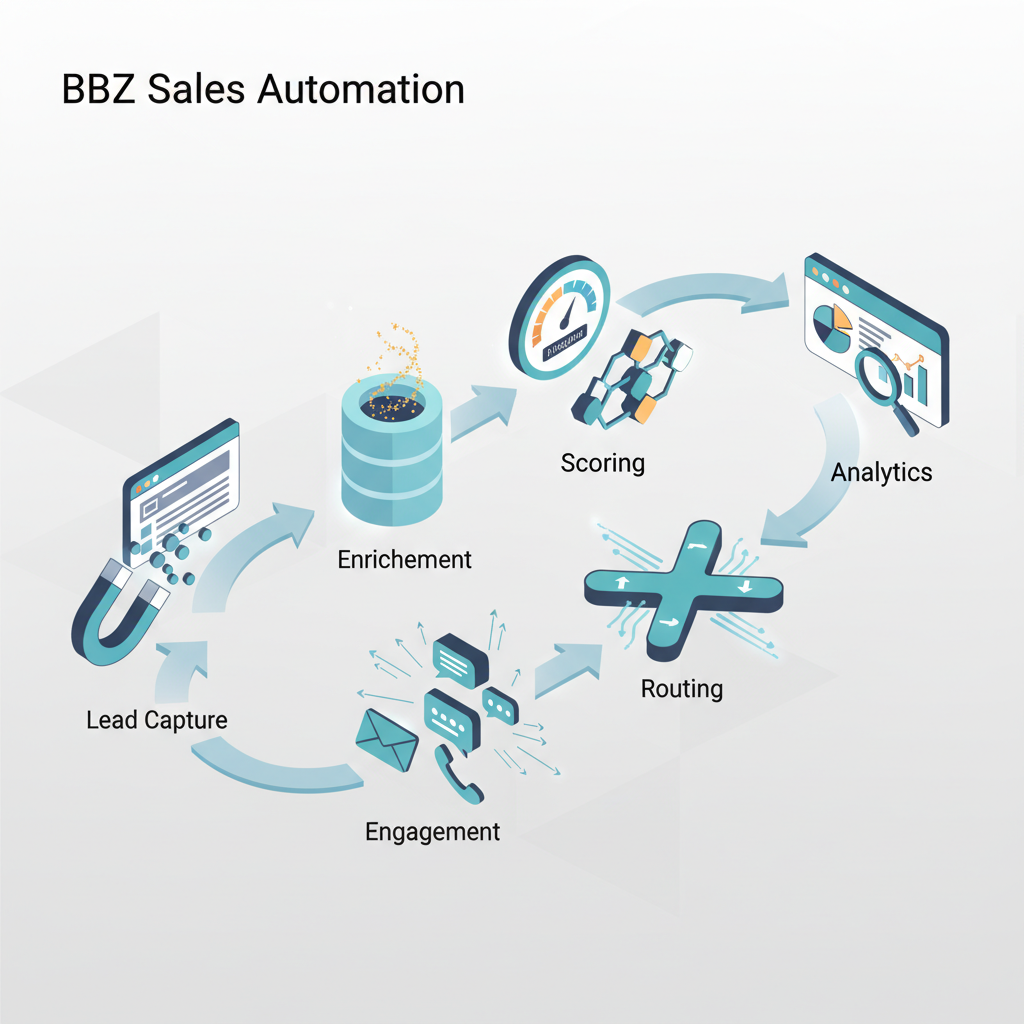
A modern sales automation workflow consists of six interconnected components. Each plays a distinct role in converting raw signals into closed deals.
| Component | Function | Example Capability |
|---|---|---|
| Lead Capture | Ingests signals from forms, chat, LinkedIn, website visits | De-anonymizes website visitors, captures form submissions |
| Data Enrichment | Appends firmographics, technographics, contact details | Adds company size, industry, verified emails |
| Lead Scoring | Assigns predictive scores based on fit and intent | AI analyzes engagement patterns and historical win data |
| Lead Routing | Assigns leads to appropriate reps or sequences | Rules-based or round-robin assignment with fallback logic |
| Engagement & Outreach | Triggers personalized multi-channel sequences | Email, LinkedIn, SMS cadences |
| Analytics & Feedback | Measures conversion, surfaces insights, refines scoring | Closed-loop feedback to marketing |
"High-growth teams face a brutal reality: as lead volume scales, manual qualification becomes impossible," notes Orbit AI. This is why each component must work together seamlessly.
On the enrichment side, platforms like Zapier's Lead Router consolidate routing logic into a single step, applying fallback rules so no leads are dropped. For scoring, AI systems analyze form responses in real-time to determine lead quality instantly, then route high-scoring leads directly to sales while lower scores trigger nurture sequences automatically.
Platforms such as Orange Slice already combine real-time market intelligence with programmable workflows, letting RevOps teams skip glue-code entirely.
The average sales tech stack includes 8.3 tools costing $187/rep/month, according to a benchmark of 938 B2B companies. Reducing tool overlap and ensuring seamless data flow between components is essential for maximizing ROI.
Key takeaway: Modern workflows require tight integration across capture, enrichment, scoring, routing, engagement, and analytics to convert signals into revenue efficiently.
How Do You Measure the ROI of Sales Workflow Automation?
Measuring ROI requires tracking both efficiency gains and revenue impact. The formula is straightforward:
ROI = (Revenue Lift + Time Saved Value – Tool Cost) / Tool Cost × 100%
Benchmark data provides clear guidance on what to expect:
| Metric | AI-Augmented | Traditional | Improvement |
|---|---|---|---|
| Revenue per rep | $1.75M | $1.24M | +41% |
| Activities per month | 178 | 217 | -18% |
| Manual task time | 20% | 52% | -62% |
| ICP targeting precision | 78% | 52% | +50% |
Sellers who frequently use AI generate 77% more revenue than those not using AI at all. The productivity gap is substantial and widening.
AI maturity matters enormously. Tools with an AI Native Score above 80 achieve 2.8x higher ROI (241%) compared to non-AI tools (87%). Time to Value also differs dramatically: AI CRM achieved fastest Time to Value at 7 days versus 90 days for traditional CRM.
One often-overlooked cost is tool overlap. Research shows 73% of sales teams use overlapping tools with 40-60% functional redundancy, wasting $2,340/rep/year. Consolidating your stack is itself a form of ROI improvement.
Key takeaway: Track revenue per rep, time saved, and tool overlap alongside traditional metrics to get an accurate picture of automation ROI.
How to Build an Automation Stack That Scales
Building a scalable automation stack requires strategic decisions about integration, AI capabilities, and governance. The winning strategy is to assemble pre-built integration tools so your team can focus on unique AI logic rather than plumbing.
"AI agents in Go-to-Market aren't science fiction anymore. They're shipping in production right now," notes Composio's GTM guide. "The bottleneck for building powerful AI agents is almost always integration."
Some companies are achieving 78% higher conversion rates after implementing AI-driven strategies. But reaching that level requires deliberate architecture decisions.
Choosing Your Integration Layer
Three main integration philosophies dominate the market:
| Approach | Best For | Strength | Consideration |
|---|---|---|---|
| AI-Native SDKs (e.g., Composio) | Developers building AI agents | Speed and breadth of action | Requires technical resources |
| Integration Infrastructure (e.g., Nango) | Deep, custom integrations | Control and depth of data | More hands-on management |
| AI-Augmented iPaaS (e.g., Tray.io, Workato) | Visual, rule-based workflows | Accessible to RevOps teams | Less suited for dynamic AI reasoning |
Observability is a critical differentiator for 2026. An orchestration platform is significantly less effective without a debugger for AI reasoning. When evaluating platforms, prioritize those with built-in monitoring and transparency into how decisions are made.
LangGraph's open Agent Protocol allows agents to communicate across frameworks via standardized APIs, reducing vendor lock-in. Microsoft is also merging AutoGen with Semantic Kernel into the new Microsoft Agent Framework, targeting production readiness by Q1 2026.
Selecting an AI-First CRM or Engagement Hub
The biggest shift in 2026 is the move from AI that suggests to AI that acts. Modern CRM platforms now use artificial intelligence to score leads, draft personalized outreach, predict deal outcomes, and even conduct autonomous sales conversations.
There are two broad categories:
AI-First Platforms are built from the ground up for automation. These include tools like Clay (a data enrichment and workflow automation engine aggregating over 150 data providers), Instantly (designed for AI-driven cold email at scale), and Clarify (which built Ambient Intelligence into its core so the CRM works autonomously without prompting).
Traditional CRMs with AI Add-Ons include Salesforce (with Agentforce), HubSpot (with Breeze AI), and Freshworks (with Freddy AI). These offer strong AI capabilities layered onto established platforms.
The results speak clearly: 83% of sales teams using AI grew revenue last year, compared to 66% without it. Companies using AI-enabled platforms report 30% higher win rates and 25% faster deal cycles.
Key takeaway: Prioritize AI-native architectures where possible, and ensure your integration layer supports transparent, observable workflows.
Automating Lead Scoring, Routing & Follow-Up
Lead scoring, routing, and follow-up form the operational heart of sales automation. When executed well, they dramatically improve speed-to-lead and conversion rates.
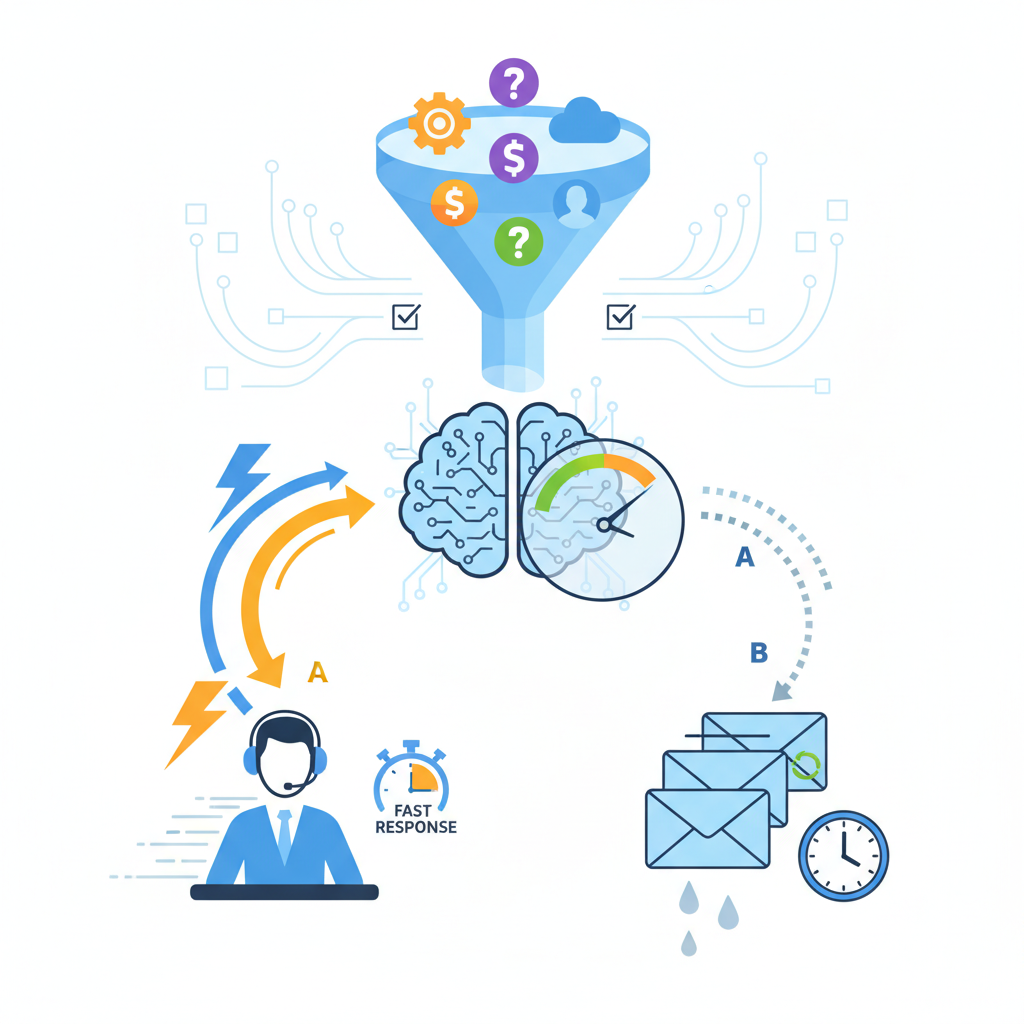
Start with scoring. AI systems ingest form fills, chat transcripts, and third-party intent data in real time, then enrich each record and assign predictive scores. Orbit AI, for example, scores leads at the point of capture using intelligent analysis of form responses. High-scoring leads flow directly to sales while lower scores trigger nurture sequences automatically.
Routing must be fast and reliable. Zapier's Lead Router includes built-in fallback logic with overflow rules, backup assignments, and queue management to ensure no leads are dropped when primary reps are unavailable. It connects with any of the 8,000+ apps in Zapier's ecosystem, including Salesforce, HubSpot, and Pipedrive.
Speed matters enormously. Research shows reps who contacted leads within 5 minutes yielded 900% more conversions than those who waited 10 minutes. Yet 79% of leads never convert due to poor nurturing and qualification.
The scoring model itself should layer multiple signal types:
- First-party web and email engagement (page visits, email opens, clicks)
- Firmographic and ICP fit (company size, industry, title)
- Third-party intent data (topic research, competitor comparisons)
- Technographic and product usage indicators (tech stack, feature adoption)
Non-AI lead scoring tools failed 64% of the time with an average ROI of -18%, versus AI-powered alternatives achieving 89% success rate and 156% ROI. The difference is substantial.
Key takeaway: Combine multi-layer scoring with instant routing and fallback logic to maximize speed-to-lead and conversion rates.
What Pitfalls and Compliance Risks Should You Watch?
Automation creates risks alongside benefits. Data quality failures, compliance violations, and deliverability problems can undermine even well-designed workflows.
Data Quality Failures
Poor data quality costs organizations at least $12.9 million per year on average, according to Gartner. Lead enrichment becomes a bottleneck when it is manual, inconsistent, and disconnected from revenue workflows. The result is slow follow-up, misrouting, and unreliable attribution.
GDPR and Privacy Compliance
GDPR compliance is non-negotiable for businesses using AI tools in sales. By 2025, GDPR fines reached €5.88 billion, with regulators increasingly using AI to detect violations.
Key requirements include:
- Explicit consent for cold outreach in the EU (legitimate interest is no longer sufficient)
- Transparency, data minimization, and purpose limitation
- Data Protection Impact Assessments (DPIAs) when AI systems engage in large-scale behavioral monitoring
- Clear opt-out mechanisms in all communications
"GDPR doesn't say 'Don't send cold emails'. It says, 'If you send cold emails, respect personal data, and have clear reasons for outreach'." Understanding this distinction is essential.
CCPA and U.S. Privacy Changes
As of January 1, 2026, businesses face enhanced CCPA requirements covering automated decision-making technology and mandatory opt-out confirmations. The EU AI Act (enacted 2024) also creates a risk-based framework banning certain high-risk AI uses.
Deliverability Risks
Without a dedicated safety layer, unlocking the speed of a sales engagement platform often leads to domain exhaustion. Authenticate domains (SPF, DKIM, DMARC), validate lists before sending, ramp volume slowly, keep complaint rates low, and monitor bounces weekly.
Key takeaway: Build compliance checks and data quality monitoring into your workflows from day one. Retroactive fixes are far more costly.
What's Next: Agentic AI & Autonomous SDRs
The next evolution of sales automation is agentic AI: systems that do not just assist but act autonomously on multi-step workflows.
"AI SDRs moved from pilots to production," reports the State of AI SDR Industry 2026. "Teams that win blend humans + AI into one integrated workflow."
Adoption is mainstream. With more than 70% of sales teams using AI, companies that delay are giving competitors an edge. The AI-powered sales tools market is growing at 42% annually.
Agentic AI platforms are now designed to autonomously execute Go-to-Market strategy. According to PwC, two-thirds of adopters report increased productivity, and over half see significant cost savings. McKinsey reports that 23% of organizations are already working on scaling agentic AI systems.
IDC's Michelle Morgan puts it directly: "This disparity between non-investors and early adopters indicates that revenue technology organizations are at an inflection point, where those without agentic AI strategies risk falling behind competitors."
40% of organizations are already scaling AI across revenue functions. The shift from AI as assistant to AI as autonomous executor is happening now.
Key takeaway: Agentic AI is not a future trend. It is production-ready today. Teams that integrate human and AI workflows will outperform those relying on either alone.
Key Takeaways & Next Steps
Sales workflow automation has moved from experimental to essential. The teams achieving the strongest results share common characteristics: they automate end-to-end workflows rather than isolated tasks, they measure ROI rigorously, and they treat compliance as a feature rather than an afterthought.
To get started:
- Audit your current stack for overlap and integration gaps
- Prioritize AI-native tools with high AI maturity scores
- Implement multi-layer lead scoring combining fit and intent signals
- Build compliance into workflows from day one
- Measure what matters: revenue per rep, time saved, conversion lift
For teams that need to build and iterate go-to-market workflows quickly, Orange Slice offers a programmable intelligence and automation layer that connects buyer intent, market research, and CRM operations into a single unified system. The platform enables companies to encode their sales logic, qualification criteria, and routing rules into transparent workflows that continuously operate across inbound, outbound, and CRM processes. Backed by Y Combinator and designed for GTM agencies and high-growth teams, Orange Slice can "scrape websites, monitor LinkedIn, enrich your CRM, build automated workflows, and research competitors – all on autopilot."
The gap between automation leaders and laggards is widening. The question is not whether to automate, but how quickly your team can move.
Frequently Asked Questions
What is sales workflow automation?
Sales workflow automation involves using AI-driven software to capture buyer signals, enrich data, score leads, and automate outreach, transforming fragmented tasks into a seamless pipeline that enhances sales efficiency and effectiveness.
Why is sales workflow automation important for B2B SaaS teams in 2026?
In 2026, sales workflow automation is crucial for B2B SaaS teams to manage complex tech stacks and meet revenue targets. It enables teams to automate repetitive tasks, allowing sales reps to focus on high-value activities, thus improving productivity and competitiveness.
What are the core components of a modern sales automation workflow?
A modern sales automation workflow includes lead capture, data enrichment, lead scoring, lead routing, engagement and outreach, and analytics and feedback. These components work together to convert raw signals into closed deals efficiently.
How can B2B SaaS teams measure the ROI of sales workflow automation?
Teams can measure ROI by tracking efficiency gains and revenue impact, using metrics like revenue per rep, time saved, and tool overlap. AI-powered tools often show significant improvements in these areas compared to traditional methods.
What role does Orange Slice play in sales workflow automation?
Orange Slice provides a programmable intelligence and automation layer that integrates buyer intent, market research, and CRM operations, enabling B2B SaaS teams to automate and optimize their sales workflows effectively.
Sources
- https://www.gong.io/files/gong-labs-state-of-revenue-ai-2026.pdf
- https://www.mckinsey.com/capabilities/growth-marketing-and-sales/our-insights/agents-for-growth-turning-ai-promise-into-impact
- https://optif.ai/media/articles/sales-tech-stack-benchmark-2025
- https://www.saleswingsapp.com/inside-sales/how-to-prioritize-high-volume-b2b-leads-2026-playbook/
- https://everworker.ai/blog/automated_lead_enrichment_ai_pipeline
- https://orbitforms.ai/blog/automated-lead-scoring-tools
- https://zapier.com/l/leadrouter
- https://www.orangeslice.app/
- https://composio.dev/blog/ai-agent-gtm-integrations-guide
- https://www.digitalapplied.com/blog/ai-workflow-orchestration-platforms-comparison
- https://pinggy.io/blog/best_ai_driven_crm_for_automating_your_sales/
- https://www.salesforge.ai/blog/clay-ai-gtm-workflows-2026
- https://aisdr.com/ai-sdr-industry-report/
- https://www.fullcast.com/content/agentic-ai-platforms/
- https://www.outreach.io/resources/reports-guides/2025-agentic-ai-revenue-intelligence-idc-report